
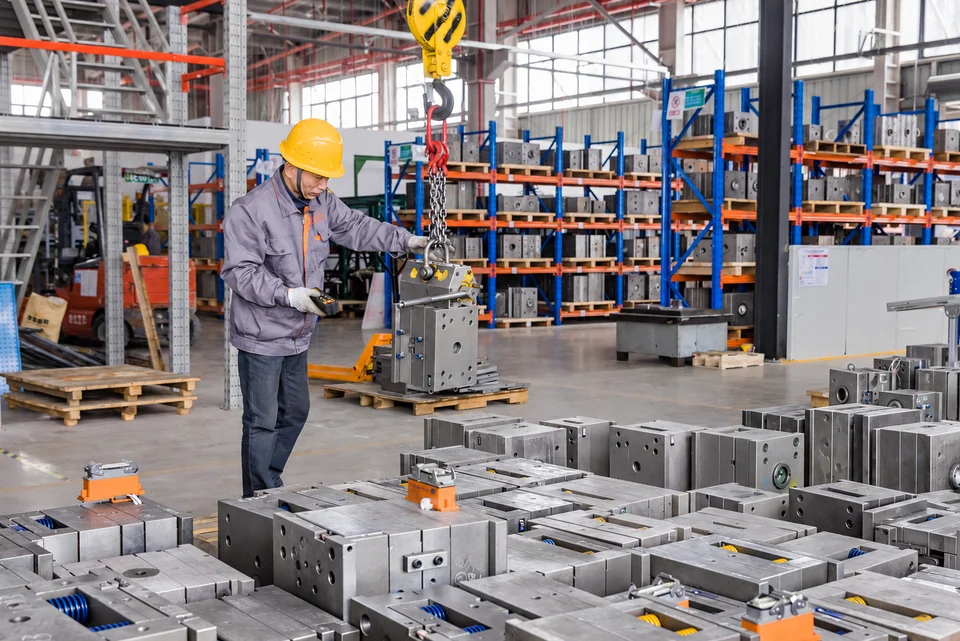
Multi-cavity molds, including the 2-cavity and 4-cavity tools often requested for small parts, are sized first from annual volume and part weight, then checked against runner balance, cavity-to-cavity consistency, and the cost of the tool versus the piece price. A higher cavity count is not automatically the cheaper or safer choice. This guide explains how that decision is framed for a production mold. It does not rate mold life, name a press size or promise a dimensional result.
Dongying (Suzhou Dongying Electronic Technology Co., Ltd.) builds precision molds and molds functional components in Suzhou, China. Small catalog parts such as bearing cages are often discussed as 2-cavity or 4-cavity work, but those pages describe those parts only. For a new project we review the drawing, the named grade, the yearly quantity and the supply scope before proposing a cavity count.
How annual volume sets a starting cavity count
Short answer: annual volume and an estimated cycle time give a minimum number of cavities; that minimum is then rounded to a practical even layout such as 2, 4 or 8, and only then checked against weight, balance and cost.
Autodesk lists required product quantity, available production time and mold cost among the factors that decide how many cavities a runner system should feed (Autodesk, Selecting the number of cavities). The year's demand is converted into molding time (quantity × estimated cycle time) and divided by the productive time the press will actually run. That minimum is usually rounded up to a symmetrical count such as 2, 4 or 8, because even layouts are easier to fill together. Odd counts are possible, but harder to balance.
If most of the volume arrives in a few peak months, size the discussion to that peak, not only to the twelve-month average. A cycle-time figure at this stage is a planning input, not a quoted cycle.
| What you already know | What is usually discussed first |
|---|---|
| Modest annual volume, or a design that is still changing | 1-cavity or 2-cavity |
| Moderate volume, small identical parts, frozen design | 2-cavity or 4-cavity |
| High volume, small identical parts, a stable process window | 4-cavity or higher, if balance, shot size and mold envelope allow |
These rows are starting points for a discussion, not a quotation and not a capacity statement.
How part weight and size cap that number
Short answer: part weight and projected area grow with every cavity, so a heavier or larger part may still need fewer cavities than a light, compact part at the same annual volume.
The same Autodesk guidance also lists clamp force, available shot volume, and the shape and size of the moldings as limits. Each added cavity increases the total projected area and the shot (parts plus runner). Fattori notes in Plastics Technology that doubling cavitation reduces piece price only if the machine and labor required do not also double, and that mold width, stack height and shot size can force a larger press even when the part itself is small (Fattori, quoting molded parts, Part 3).
We evaluate those limits for each project and do not publish a machine-tonnage table. Insert-molded parts add loading time and the need to confirm that every nest has an insert; see insert-molding inputs.
Balance and cavity-to-cavity consistency
Short answer: a geometrically balanced runner (equal flow length to each cavity) is the starting layout, but shear in the runner can still fill some cavities earlier, so balance should be checked, not assumed.
A ladder or fishbone runner fills the cavities nearest the sprue first. The usual correction is a geometrically balanced layout: equal flow length and symmetrical cross-sections to every gate. That remains the right starting point (Beaumont Technologies; Fattori also treats it as the baseline).
Even then, shear heating along the runner wall can send a hotter, lower-viscosity layer down one branch, so some cavities fill earlier and pack differently (Beaumont Technologies, naturally balanced runners). Typical symptoms are short shots, flash, or cavity-to-cavity size scatter.
As cavity count rises, a filling study and a short-shot balance check belong in the tooling discussion, together with whether further runner work — including a rheological, or melt-rotation, approach — is warranted. Equal runner length is not a promise that every cavity will match. Parts should be traceable to a cavity identity so variation can be reviewed under the inspection and approval plan.
Multi-cavity versus family molds
Short answer: a multi-cavity mold repeats the same part in every impression; a family mold puts different parts of a set into one tool, and those different volumes must finish filling together.
Family layouts can reduce the number of tools for a set that is always used together, but they are harder to fill evenly. Autodesk shows that equal-length, equal-diameter runners fill the smallest cavity first and overpack it, while the largest fills last (Autodesk, unbalanced flow in family molds). The usual correction is to restrict the runner to the smaller parts so every cavity finishes filling together — not merely starts together — so packing pressure and shrinkage stay comparable. Changing only the gate size changes speed through the gate; the runner flow area should be adjusted (Fattori, three-plate molds). A gear and a housing are not automatically a family-mold candidate if they differ widely in volume, wall thickness or resin; see our gearbox housing and gear molding article.
Other limits: design maturity, inserts and tool cost
Short answer: an unsettled design, insert loading and the payback on a larger tool can all argue for fewer cavities, even when the volume formula points higher.
Every drawing change has to be cut in every cavity. If the design is still moving, a 1-cavity or 2-cavity tool limits how widely a revision spreads; freeze the revision before cavity steel is multiplied, as described in drawings and revisions.
Fattori recommends quoting two or three cavitation scenarios and letting the buyer decide whether to spend more on the tool or on the parts, based on how soon the higher-cavity tool would pay back (Fattori, quoting molded parts, Part 3). That comparison belongs in the tooling and supply scope: mold only, molded parts, or both, plus spare inserts and maintenance expectations. A higher cavity count is not a cost or output promise.
What to send with the RFQ
Use the injection molding RFQ checklist and add the cavity-count items below. If you do not yet have drawings, see how we quote without drawings.
- Current 2D drawing and 3D model, with the revision clearly marked.
- Expected annual volume, and any sharp seasonal peak if you know it.
- Named resin grade, and whether substitutes are allowed.
- Part weight if you have it; otherwise the 3D model so it can be calculated.
- Whether the tool should repeat one part or hold a family of different parts.
- Critical features that must match from cavity to cavity, and cosmetic faces.
- Whether you need the mold, molded parts, or both.
- For insert-molded parts, who supplies the inserts and how they will be loaded.
When that package is ready, prepare a project brief. Application context for the part families we discuss most often is on the applications page.
FAQ
Can you build multi-cavity molds, such as 2-cavity or 4-cavity, for small parts?
Yes. We review 2-cavity, 4-cavity and other multi-cavity layouts for small identical parts against your annual volume, part weight and quality needs. Catalog examples such as bearing cages are often discussed this way, but the cavity count for a new part is proposed only after those inputs are reviewed. Send the drawing, the named grade and the yearly quantity so those options can be compared.
How is the number of cavities decided?
Annual volume and an estimated cycle time give a minimum cavity count: the molding time the year's demand needs is divided by the productive time the press will actually run, then rounded to a practical even layout. Part weight, shot size, runner balance, design maturity and tool cost can change that number. We usually compare two or three layouts rather than locking one count in the first discussion.
Why do you need both annual volume and part weight?
Volume tells us how many parts must come out of the tool in a year; weight and size tell us whether that output still fits a given cavity count. A small, light part can often support more cavities than a heavier one at the same yearly quantity, because total shot weight and projected area grow with every cavity. If demand spikes in a few months, use the peak, not only the yearly average.
What is the difference between a multi-cavity mold and a family mold?
A multi-cavity mold repeats the same part in every impression. A family mold puts different parts of a set into one tool. Family layouts can reduce the number of tools for a matched set, but they are harder to fill evenly: equal runners will fill the smallest cavity first and overpack it. The usual correction is to restrict the runner to the smaller parts so every cavity finishes filling together.
Why can cavities still fill unevenly when runner lengths are equal?
Equal flow length is the right starting layout, and it is a clear improvement over a ladder or fishbone runner. Even then, shear heating along the runner wall can send hotter, easier-flowing melt down one branch after an intersection, so some cavities fill earlier and pack differently. A filling study and a short-shot balance check show whether the layout needs further runner work.
What should I send in an RFQ so you can propose a cavity count?
Send the current 2D drawing and 3D model with the revision, expected annual volume (and any sharp seasonal peak), the named resin grade, and whether you want identical cavities or a family set. Include part weight if you have it, critical features that must match from cavity to cavity, and whether you need the mold, molded parts or both. For insert-molded parts, say who supplies the inserts.
References
- Autodesk, Selecting the number of cavities (Moldflow Communicator help)
- Autodesk, Unbalanced flow in family molds (Moldflow Insight 2026 help)
- Jim Fattori, Get Better at Quoting Injection Molded Parts: Part 3, Plastics Technology (20 January 2021)
- Jim Fattori, How to Design Three-Plate Molds, Part 1, Plastics Technology (13 September 2023)
- Beaumont Technologies, Beware of the “Naturally Balanced” Runner System